Lifting weights is one of the most effective ways to build strength and muscle, yet countless gym-goers sabotage their progress through biomechanical errors that compromise both safety and results. Understanding the science behind proper form isn’t just about looking good in the mirror—it’s about optimizing force production, reducing injury risk, and ensuring your muscles receive the stimulus they need to grow. When you lift with poor biomechanics, your nervous system recruits muscles inefficiently, meaning you’re not fully activating your target muscle groups. Additionally, improper movement patterns place excessive stress on joints, connective tissues, and stabilizer muscles that weren’t designed to handle such loads. The good news is that most common lifting mistakes stem from predictable biomechanical principles that are entirely correctable. By learning why these errors occur at the mechanical level, you can make informed adjustments to your training. This article explores the science behind eight prevalent lifting mistakes and how understanding their biomechanics can transform your training effectiveness.
One of the most widespread mistakes is excessive forward knee travel during squats, often called “knees over toes” concerns. Biomechanically, some forward knee translation is completely normal and necessary for proper squat mechanics, but excessive travel indicates several underlying issues. When your torso leans too far forward, your center of mass shifts anteriorly, forcing your knees to travel further forward to maintain balance. This happens because your posterior chain—glutes, hamstrings, and erector spinae—isn’t engaging adequately to support a more vertical torso position. The consequence is increased shear forces on the knee joint and reduced glute activation, meaning your legs don’t receive optimal stimulus. Your quads work harder to compensate, but they’re working at a mechanical disadvantage. The fix involves improving ankle mobility, strengthening your core, and focusing on sitting back into the squat by initiating the movement with your hips. When performed correctly, your knees naturally track over your toes without excessive forward translation, distributing forces across your entire lower body more efficiently.
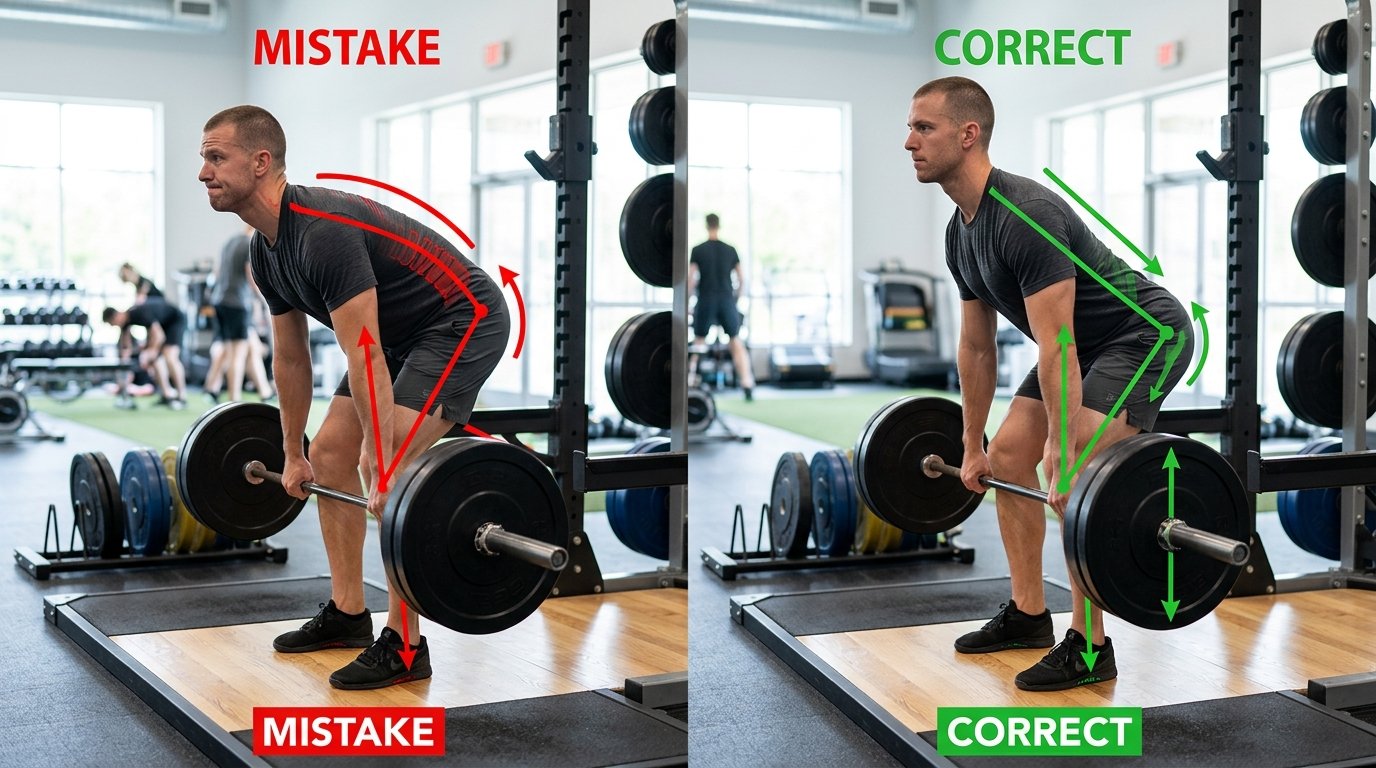
Rounding your lower back during deadlifts represents a critical biomechanical failure that deserves serious attention. Your lumbar spine consists of vertebrae stacked vertically, designed to handle compressive forces exceptionally well but vulnerable to shear forces and flexion under load. When you round your lower back during a deadlift, you’re placing your intervertebral discs in a compromised position where the nucleus pulposus—the gel-like center—can shift posteriorly toward the nerve roots. Simultaneously, your erector spinae muscles are placed in a mechanically disadvantageous position, unable to generate sufficient force to support the load. This forces your passive structures—ligaments and disc material—to bear more stress than they’re designed to handle. The biomechanical solution involves maintaining neutral spine position by engaging your core, retracting your scapulae, and initiating the pull by driving through your legs. Proper deadlift mechanics distribute forces across multiple muscle groups and structures, transforming the movement from a dangerous position into one of the most effective full-body exercises available.
Shoulder impingement during pressing movements often results from poor scapular mechanics and inadequate thoracic mobility. When you press weight overhead or horizontally, your scapula must upwardly rotate and retract properly to create space in the subacromial region where your rotator cuff tendons pass through. Many lifters fail to achieve this scapular positioning, instead relying excessively on their anterior deltoids and chest while their scapulae remain protracted and internally rotated. This narrows the subacromial space, causing your rotator cuff tendons to compress against the acromion process—a condition called impingement. The biomechanical consequence is reduced force production, increased injury risk, and eventual shoulder pain that limits training. Correcting this requires addressing multiple factors: improving thoracic extension mobility through targeted stretching, strengthening your lower traps and serratus anterior to promote proper scapular positioning, and reducing your range of motion if necessary until mobility improves. When scapular mechanics are optimized, pressing movements become safer, more powerful, and pain-free.
Excessive lumbar extension during bench press represents another common biomechanical error that reduces exercise effectiveness. Your spine isn’t designed to generate force through hyperextension, yet many lifters unconsciously arch excessively to lift heavier weights or achieve a false sense of stability. While some arch is biomechanically sound—it helps stabilize your torso and allows for proper scapular retraction—excessive extension shifts the exercise focus away from your chest and toward your anterior deltoids and triceps. This happens because your body’s biomechanical efficiency decreases when your spine is hyperextended, forcing secondary movers to compensate. Additionally, excessive arching places unnecessary stress on your lumbar discs and facet joints. The optimal bench press position involves a moderate arch that maintains neutral spine alignment while allowing your shoulder blades to retract and depress appropriately. Your feet should drive into the floor to create full-body tension, and your core should remain braced without hyperextending your lumbar spine. This balanced approach maximizes chest activation while maintaining spinal safety.
Elbows flaring excessively during bench press movements compromises both shoulder health and chest activation. Biomechanically, when your elbows position perpendicular to your torso, you’re placing your shoulder joints in external rotation under load—a mechanically vulnerable position. This excessive external rotation increases stress on your anterior shoulder capsule and rotator cuff, while simultaneously reducing mechanical advantage for your chest muscles. Your pectorals work most efficiently when your elbows remain at approximately forty-five degrees relative to your torso, creating a balanced angle that maintains shoulder safety while optimizing force production. At this angle, your chest muscles work through a full range of motion while your shoulders remain in a more stable position. Additionally, excessive elbow flare shifts the load toward your anterior deltoids, reducing the stimulus your pectorals receive. The fix is simple: maintain a controlled elbow angle, lower the bar to your mid-chest rather than your neck, and focus on driving your elbows slightly inward as you press. This biomechanically sound approach protects your shoulders while maximizing chest development.
Inadequate hip hinge mechanics during rows and deadlift variations represents a fundamental biomechanical mistake that limits strength development. Your hip hinge is a foundational movement pattern where your torso rotates around your hip joint while maintaining neutral spine position. Many lifters fail to achieve true hip flexion, instead compensating with excessive spinal flexion or remaining too upright. When you don’t properly hinge at your hips, you lose the mechanical advantage provided by your posterior chain muscles—your glutes and hamstrings—which are among your body’s strongest muscles. Instead, your lower back and mid-back muscles must bear excessive load, limiting how much weight you can handle and increasing injury risk. Biomechanically, the hip hinge allows you to maintain a strong, stable spine position while your legs and hips generate the majority of force. Practicing the movement pattern with light weight, focusing on feeling your hamstrings stretch as you descend, helps develop proper motor control. Once mastered, the hip hinge transforms your pulling movements into powerful, efficient exercises.
Finally, neglecting scapular engagement during pulling movements prevents optimal lat activation and limits back development. Your latissimus dorsi muscles originate on your spine and insert on your humerus, meaning they function most effectively when your scapula moves through its full range of motion. Many lifters perform rows and pull-ups without properly depressing and retracting their scapulae, essentially shortening their range of motion and reducing muscle activation. Biomechanically, this means your lats aren’t working through their complete contractile range, limiting the stimulus they receive. Additionally, inadequate scapular engagement places more stress on your shoulders and elbows. The solution involves initiating pulling movements by depressing your scapulae—pulling your shoulders down and back—before flexing your elbows. This scapular positioning ensures your lats engage from the movement’s beginning, creating a longer range of motion and greater muscle activation. Understanding these scapular mechanics transforms your pulling exercises from arm-dominant movements into powerful back-building exercises that develop true strength and muscle size.